|
River Droplet Installation on Closing Night: CREDIT: Jayne Jackson Photography Public artwork is usually commissioned and exhibited in non-arts spaces; town centre spaces, estate gardens, hospitals, commercial buildings, new housing estates, etc. This differs from art exhibited in galleries which may already exist and it is meant to be site-specific. I have applied for many temporary public art commissions within the arts sector, commissions with briefs written by arts organisations. These commissions have often been designed to frame a piece of public space which will then be activated with other events such as temporary sculpture, performances and music. The ‘River Droplet’ commission I completed in September 2024 was in collaboration with Lorna Rees/Gobbledegook Theatre and was commissioned by Dorset National Landscape. There have been some interesting advantages in being commissioned by a landscape organisation rather than a body within the arts sector. ‘River Droplet’ was the pilot for Dorset National Landscape’s ‘Sitting Spaces’. The aim of ‘Sitting Spaces’ is to connect people to the local geology of a place and the landscape along with historic food production in that landscape and increase dwell time. We chose to focus on the River Frome which is a chalk stream running through Dorset and provides the perfect conditions for diverted water to be used to grow watercress. Dorset is one of the world’s largest producers of watercress. We suspended 600 bottles of water from the River Frome in a droplet formation from a temporary scaffold. The work was installed in Frampton, Dorset, on their Millenium Green and the structure became a room which hosted a range of events and music. The project was not dissimilar in form to ‘Art Vaults’ shown in Canute’s Palace, Southampton in 2018, commissioned by A Space Arts. This involved hanging 1,000 bottles of water from the Solent which related to the fact that the Old Town in Southampton is reclaimed land, once flooded by the sea. The space then hosted a month of events including live bands and temporary sculpture and performance, many related to water or seafaring. ArtVaults 2018, rope installation and workshop under the exhibit. CREDIT: Amanda Moore The main comparison between the Dorset project and the Southampton project was the key outcomes. Dorset National Landscape were aiming to highlight ‘specialness’ of the area and to attract new visitors to the Food Trail, a cycle route which runs past the location. The project was not designed specifically for arts visitors, those who are already interested in the arts. It was installed in an unexpected location, not close to an arts organisation, and did not have an invitee mailing list from an arts organisation. Although this meant a smaller attendance, partly due to the rural location, the advantage here was that the project attracted an audience organically over the month, from local people within the village, to cycle trail riders and those hearing about it by word of mouth. The positive feedback about the project was hard-earned and developed over time, often coming from those who were initially sceptical about art. The audience later included those with a special interest in the history of the river including farmers and geologists. That's not to say that art organisations aren't aiming to attract a diverse audience. The installation itself was extremely site-specific as the water displayed above peoples’ heads was taken from the adjacent river which is sunken down in the site, thereby showcasing it. The chalky river sediment could be seen in the bottles. The events and music put together by Gobbledegook were also incredibly site-specific and stepped outside of the art world into the world of scientists and geologists. Songs were written which could be played via QR codes in the space. The first of these was a folk song about watercress production in the chalky stream. Later, additional versions were produced which sampled the voices of local watercress growers, local residents and recordings of the river. People smiled when they heard a recording of their voice worked into the tracks when they were played via mini-rig speakers. Lorna had recorded people talking about tasting watercress and had interviewed specialists including the director of a local watercress company. People tasting watercress and being recorded inside 'River Droplet'. CREDIT: Jayne Jackson Photography Every Tuesday night we hosted ‘Glow-ming’ events which celebrated sunset and highlighted how much shorter the day became throughout the month. These events included a talk by geologist Dr Anjana Khatwa one evening, storyteller Martin Maudsley another and expert nutritionist Dr Sumanto Halder on another. The attendees all talked about a very specific aspect of the location which gave more variation to the project outside of the arts, but did rely on the visual spectacle of the chandelier of water droplets in the background to elevate the talks somewhat. Talk with Dr Sumanto Halder. CREDIT: Amanda Moore Bookmark hand-outs I created relating to different aspects of the installation during the month, commemorating the different talks. The closing event included new songs developed through the month being performed and also a fire juggling act which lit up the droplets of water with a golden glow. The performer even sourced a white outfit to represent the chalk. Throughout the events, Lorna had produced costumes including overalls for us to wear with elements about the work and local geology embroidered onto them and a chalk head piece for her to wear one evening. People became more and more engaged and were encouraged to sing or to light candles in the space. The project aimed more and more to deepen people's understanding of the location rather than become of showcase of artist's work. Fire juggling on closing night. CREDIT: Jayne Jackson Photography Another interesting aspect of all of this was that the installation became a project which evolved over the course of the month. More and more audio recordings taken were worked into the songs written for the installation. Artworks were made in the space including photographs of it lit in different ways. Events had been partly programmed at the start but also developed and changed in response to what had worked well. Even times shifted for Glow-mings due to changing sunsets and a celebration of the Harvest Moon was included with costumes and props when we realised that it was occurring whilst the installation was open. The legacy of the project is that more Sitting Spaces may be commissioned and ‘River Droplet’ is well documented and will be included in the village archives. Deeper legacy includes greater appreciation of the local landscape by residents and visitors and memories of the spectacles seen and songs played. We jotted down reactions and comments by visitors throughout the month which form part of the documentation of the project. Working on a commission with a landscape organisation over an arts organisation meant attracting a wider audience than an arts audience and improving perceptions about the worth of art and what it is for. The project also included collaborators outside of the art world who in turn brought their own wider audience. The project also had the freedom to develop over time and respond changes in the site and audience feedback, it treated the audience as participants over an audience being performed to. Dorset National Landscape attended all events as hosts, providing a welcome to visitors and tying the project back to its purpose. CREDIT: Jayne Jackson Photography
0 Comments
River Droplet installation. CREDIT: Amanda Moore ‘River Droplet’ is a temporary installation in Frampton, Dorset, that shines a light on the unique character of chalk streams in Dorset, due to open for the month of September 2024. This project follows on from the installation I completed at Canute's Palace, Southampton, in 2018. This involved hanging 1,000 bottles of water from the Solent in a wave formation from a scaffold structure. The installation referenced narratives around Canute who was said to have demonstrated that no man can hold back the tide. The bottles displayed the clay sediment found in the Solent and interestingly, brought water into the town in an area which would have belonged to the sea, this area of the Old Town being reclaimed land. The installation was activated by a series of events and performances as it allowed full use of the ground floor of the palace below and many events related to water and seafaring. River Droplet has has been commissioned by Dorset National Landscape as the first installation for the 'Sitting Spaces' project. Sitting Spaces aims to encourage a wider range of people to visit the countryside by creating temporary structures to sit and enjoy the special qualities of the area. Sitting Spaces supports the new Dorset Food Trail, which highlights the food heritage of the Frome Valley between Maiden Newton and Dorchester. The brief was to design a sitting space which highlights local geological properties of an area and relate them to food production. This encouraged me to think about the project I did in Southampton as part of a possible series, rather than a one-off. This is a new way of working for me and shows that you can often do something once, and then disregard its potential value in a different context. This installation consists of 600 bottles of water taken from the adjacent River Frome. The chalky bed of the river can be seen through the sediment in each of the bottles. Chalk streams are perfect for the production of watercress which is grown locally and shipped around the UK and across the world. It is also giving me an opportunity to work with an artist I've wanted to work with for a while, Lorna Rees of Gobbledegook Theatre, https://www.gobbledegooktheatre.com/. Lorna is bringing the installation to life with events and recordings that explore the story of watercress production and what makes chalk streams so special. She is crafting songs based on folk songs about watercress, recording audio from people including scientists and growers, and we are holding 'glow-mings' where we celebrate sunset and the illumination of the installation. Audio can be played via QR codes online. Pretty much every town and city in the UK has been created around a river and each river tells a different story. This model of showcasing the water, slowing creating a physical installation which the local community grow interest in, and activating it by telling stories, is proving to to form an interesting and valuable model for outdoor art. https://dorset-nl.org.uk/project/sitting-spaces/ Canute's Palace, Southampton. CREDIT: Amanda Moore
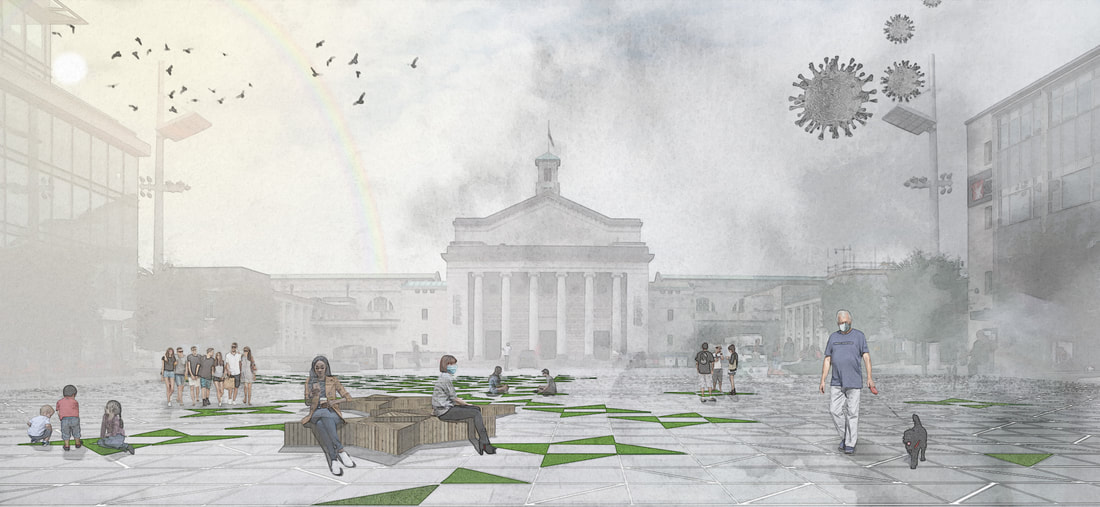
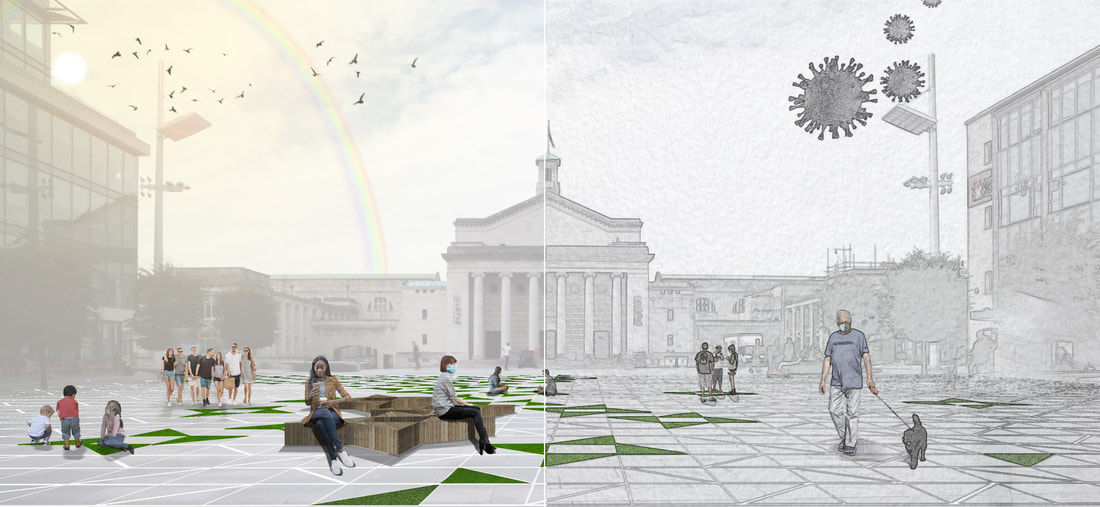
CREDIT: Amanda Moore I spend a lot of time mocking up artist impressions of projects I’m working on. I’m no good at photorealistic images and so a filter which makes them look more like hand sketches saves me the time creating a hand sketch and also doesn’t look like an early 2000s computer game still. The most useful Adobe Photoshop filter I’ve found is the ‘find edges’ one which creates a version of an image which looks like a pencil sketch. When desaturated and overlaid onto the original image, it creates a kind of watercolour effect. Here is an example of an image I did for a commission during the Covid lockdown era for People United. I designed a floor mural which could demarcate social distancing in lockdown times, and in non-lockdown times it would make a public space more interactive. You can see the difference before and after using the filter: CREDIT: Amanda Moore I created the image using a photo of the place and adding in people and the design. I then saved a copy of the layered Photoshop file and flattened the layers. I went to Filter > Find Edges to create the line drawing. I then used Mode > Grayscale to remove the colour, although you could also use the Hue/Saturation settings to just reduce the colouring. CREDIT: Amanda Moore I then copied and pasted this layer onto the original file as the top layer and played with the transparency levels. You may need to cut out bits in places using the wand selection tool if the white background is too much.
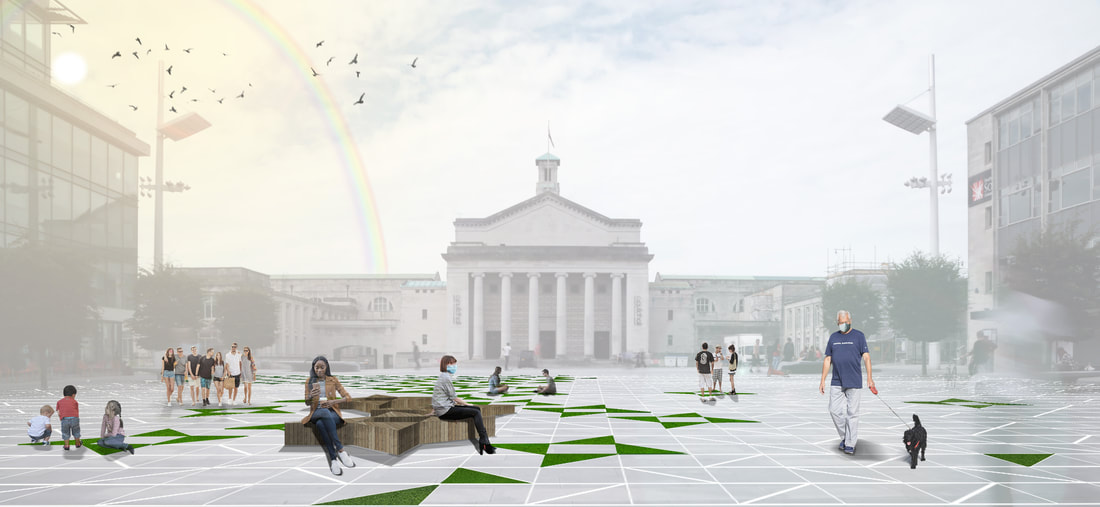
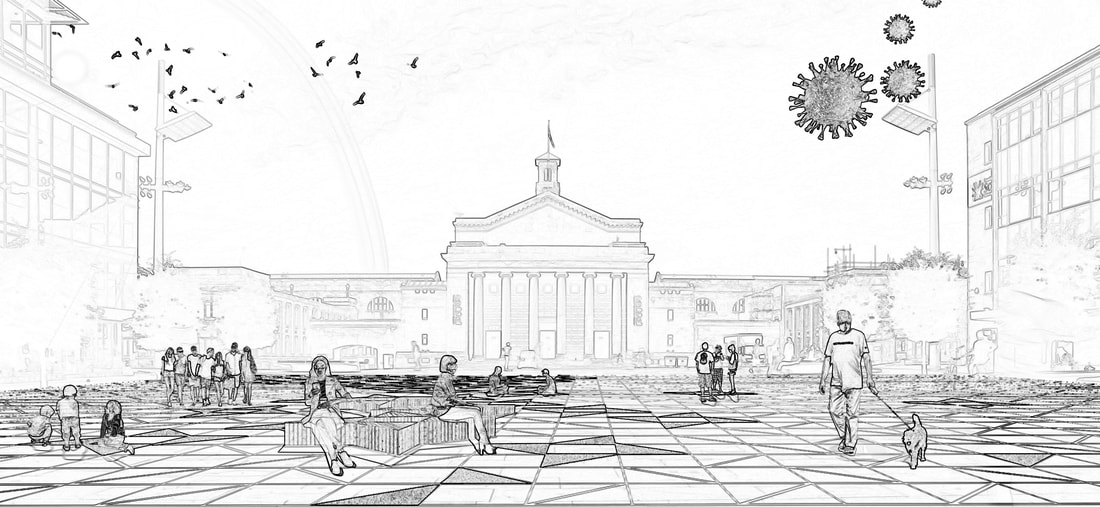
The other thing which you could add to de-realise the image further is a watercolour layer. You can find a watercolour image online and copy and paste it into your image file. Desaturate it and then reduce the transparency to around 10% or below and this adds a mottled texture. This filter has allowed me to produce many last-minute artist impressions. CREDIT: Richard Chivers. Gosport Mural, Amanda Moore 2022 Over the last two years I’ve been creating more public artwork using vinyl printing rather than hand paint or applying art traditionally. The process goes like this…design an artwork which is site-specific for the client, (usually local authority), approach a vinyl printing company to survey the site accurately and quote for the work, have them print and install the final work like outdoor wallpaper. I’ve used adhesive wraps for three types of installation:
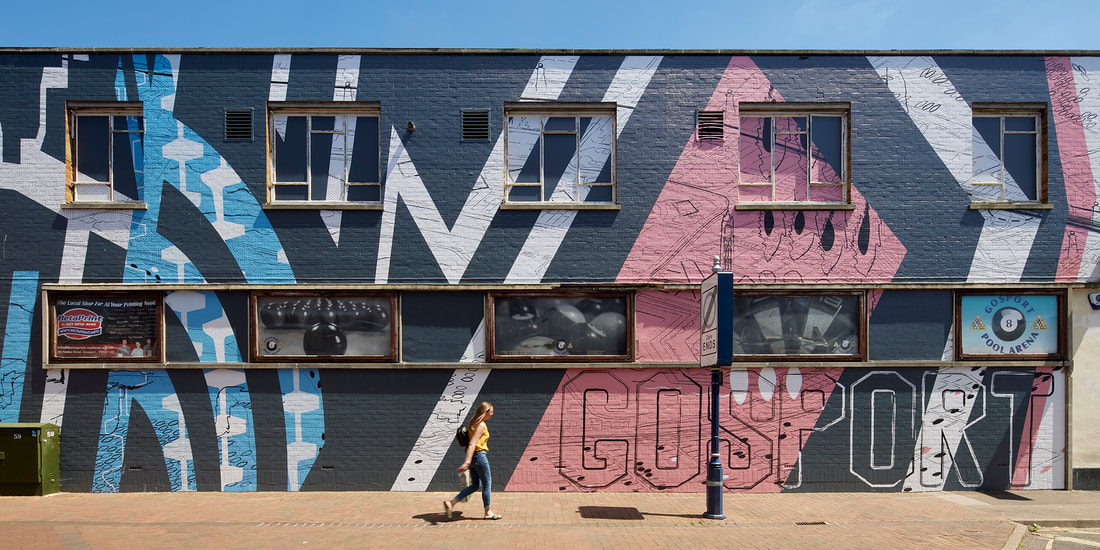
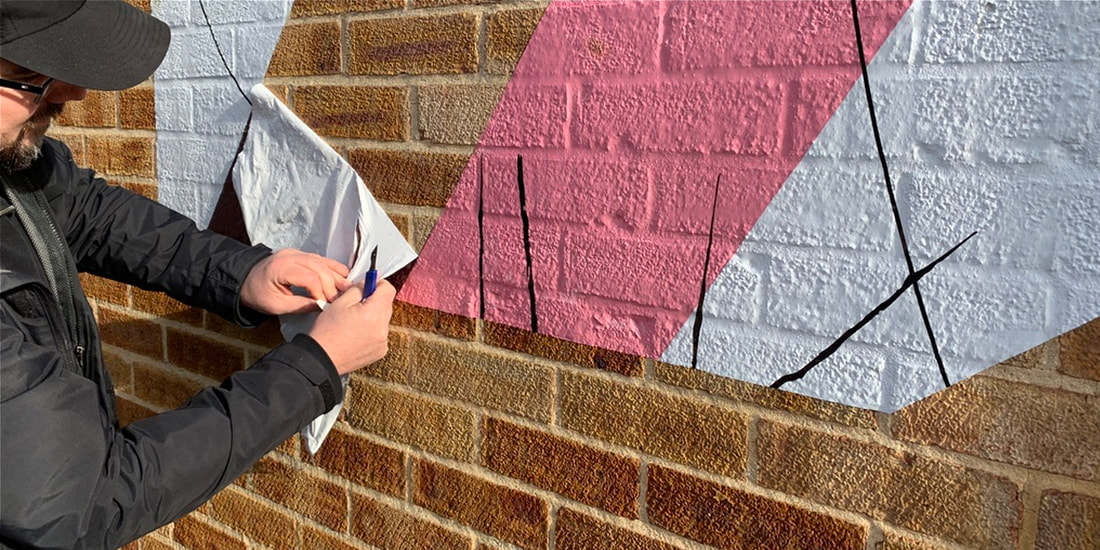
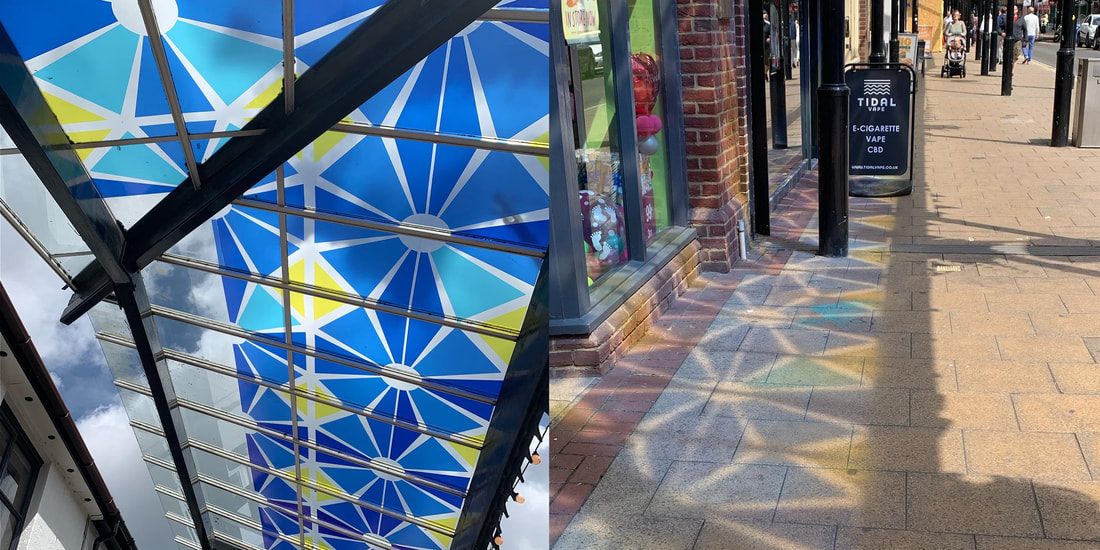
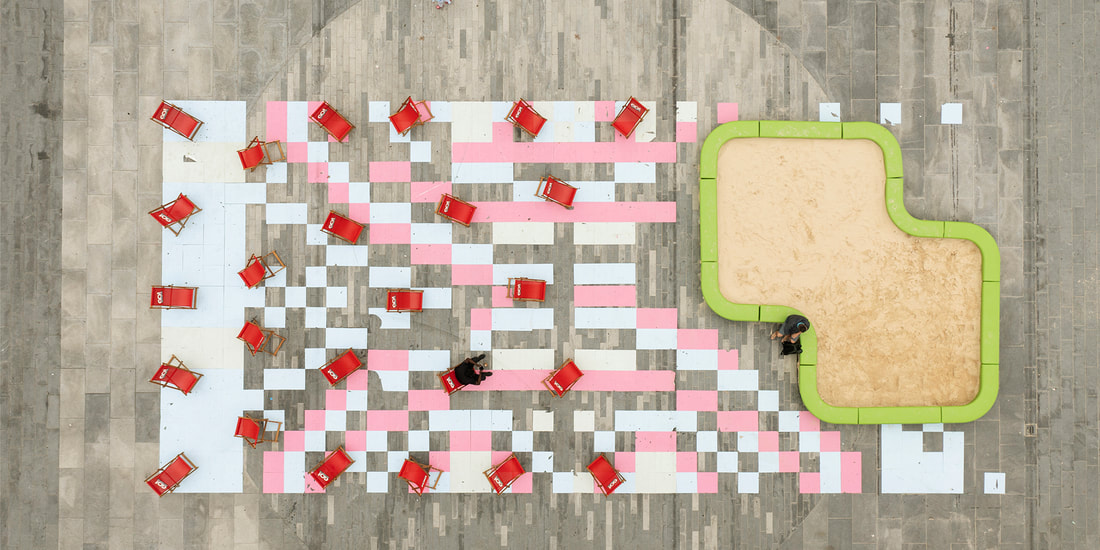
The advantage of using a vinyl printing subcontractor is speed. I tend to mock up artwork using Adobe Illustrator mostly using vector-based lines and shapes which cuts out concerns over image resolution. I then approach a subcontractor I’ve worked with previously and ask them to measure on site and quote for the work, plus provide a method statement detailing how they will install safely and any product warranties. I’ll often have a sample installed on the site so that we can see how the material will stretch over textures such as brickwork and how easily it is removed. CREDIT: Amanda Moore. Testing vinyl wrap. The project I worked on in collaboration with Studio BAD in Gosport in 2022 involved designing a wrap for a snooker hall building as part of a trail of new art within the town centre. I designed a mural which picked up on Goport’s naval heritage by taking dazzle boat painting patterns and combined this with colours and motifs seen on heritage buildings around the town. All of this was drawn in Adobe Illustrator and sent to Mac Signs based in Southampton who installed the work using a scaffold tower within a week, although this week of labour was spread out around poor weather. CREDIT: Amanda Moore. Eastleigh translucent vinyls In Eastleigh I designed a large set of translucent vinyls which were based on Art Deco patterns seen on an early twentieth century building in the town. These were installed to glazed colonnades and create reflections onto the ground. The prints were cut around the unevenly spaced mullions on site rather than needing to measure each piece of glass. The works were installed to the underside around the town, bird poop not landing on top. CREDIT: Richard Chivers. Southampton Guildhall urban rug. For Southampton’s Guildhall Square an urban rug was formed using coloured squares made from recyclable aluminium. These squares were arranged as pixels forming architectural motifs on the Guildhall building. The texture for floor art is important in terms of guaranteed slip resistance in public areas. These didn’t quite hold up as well with the local skateboarders and they tore at the edges but it worked well as a temporary installation.
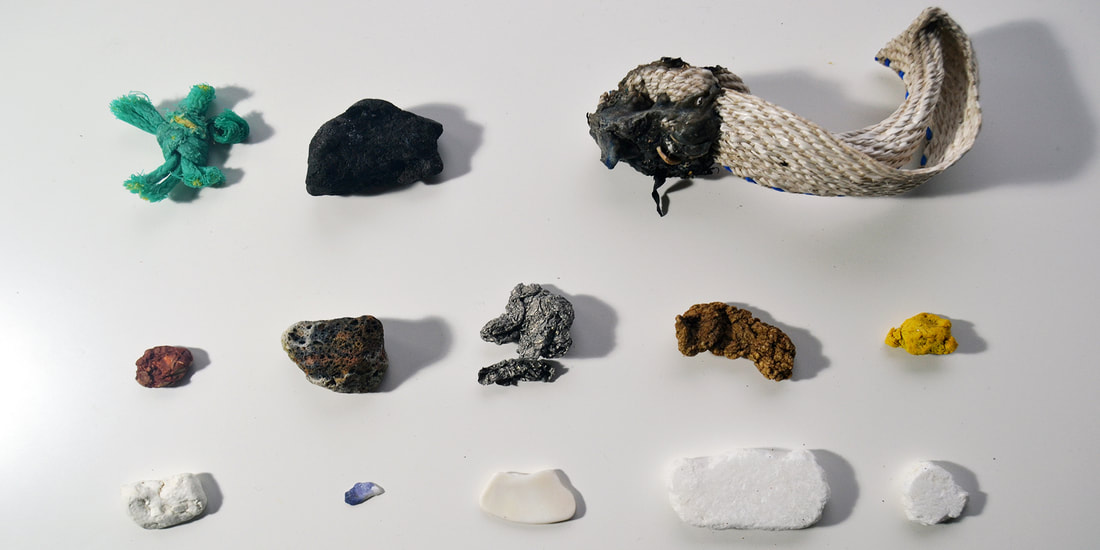
In my previous sculptural work I was often interested in making objects which were a mixture of man-made forms and natural forms, exploring how these two types of thing fit and relate.
Exploring coastal areas near to me, and looking to find objects to help to start future sculptural works, I came across many items which at first looked natural but turned out to be man-made. These included lumps which looked like rocks, but were a lot lighter, rubbery lumps, hardened polystyrene chunks, bits of rope starting to roll into small pebble shapes and fishing net fragments with shells and sea weed attached, bound together with plastic. The franken-rocks made up of many items and bound with melted plastic are apparently called 'plastiglomerates'. They are a marker of human pollution and have almost become a kind of modern geological formation, in faster time. The fishing gear fragments I found include melted plastics and formed a habitat for organic creatures as small shells and seaweed have grown into them. But how will these plastiglomerate 'rocks' weather over time? Can they act as a geological record of what is described as the Anthropocene Epoch, the period of Earth's history when human activity had a major impact on climate and ecosystems? Or will they break down or be utilised by living creatures? Can they return back to an oil and release all of their small elements? |
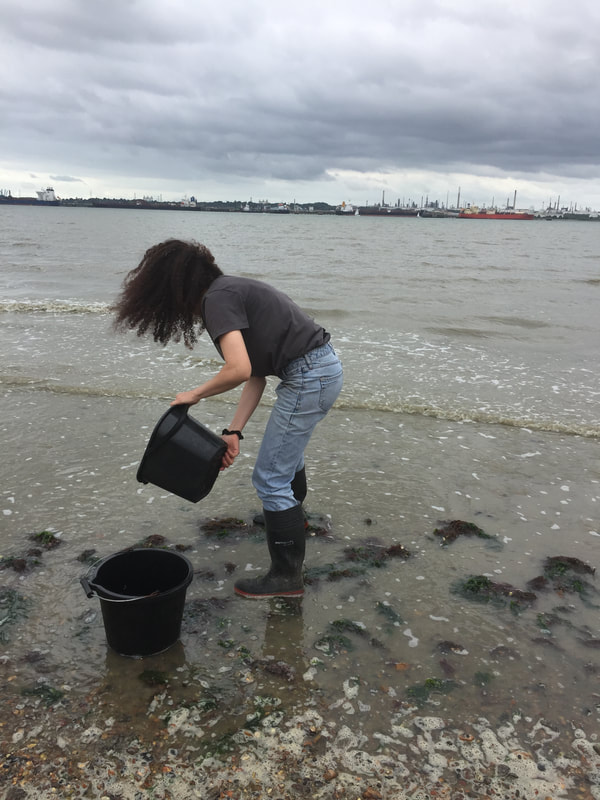
AuthorWhat am I doing here? I'm collecting sea water to fill 1,000 bottles and hang them from a scaffold inside an old ruin. Why? Why not? Archives
October 2024
Categories
All
|
RSS Feed